Auto1 Group, digital car trading without stores, Europe's No. 1

Yes, I’ll have to listen to the conference call this afternoon to see if management is bullish in their comments.

This growth rate means that the company is taking market share from its competitors. That’s an excellent sign.

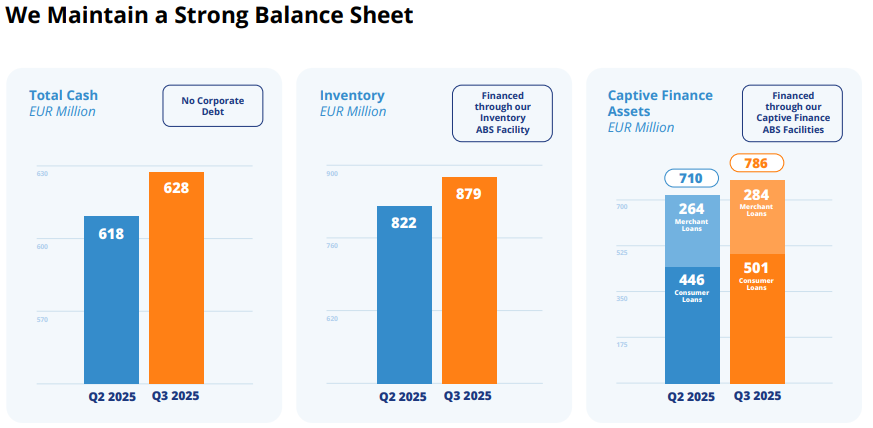
Now I’m starting to wonder what they plan to do with the 600 million euro cash pile. There’s no debt at all. Acquisitions perhaps, but are they worth it when they’re already organically pulling the rug out from under competitors?

3 Likes

One should avoid forming traditions, because over time they turn into obligations, but here it is again, the traditional earnings call review, this time for Q2. These are the most important source of information for me, as the company doesn’t otherwise announce much about itself.

The most important events of the quarter for each reader can probably be found in the report, but I’ll put some reminders here.

  • 40 new “branches” or collection points opened during Q2, supporting both the Merchant and Retail buying side and selection.
  • Autohero’s growth rate has accelerated while GPU has grown at the same time, meaning the growth has been nicely healthy.
  • Private customer financing expanded to Spain at the end of Q2, in addition to previous Germany and Austria. 3/9 of the markets are now covered by this financing.
  • The Autohero investment phase announced after Q1 is underway. This is the construction of a longer-term growth engine, the results of which are already being seen.
  • Gross profit decreased due to Easter and public holidays falling on weekdays, and OpEx swelled due to growth investments. The increase in marketing costs came practically entirely from Autohero’s brand marketing. The increase in salary costs came from additions to purchasing staff, Autohero car refurbishers, and Autohero sales staff.
  • According to updated guidance, Merchant is expected to grow 14% YoY and Retail 27% YoY this year. The rest of the market is unlikely to grow this fast :partying_face:.

Q&A Section.
Here again, I’ll freely take what I consider the most interesting answers and group them under the same topic.

Q: According to an analyst, Aramis has reported observing weakness in demand in Spain, Austria, and France. It was asked if Auto1 sees the same challenge?
A: No. According to Christian, the market for used car demand is normal and stable. The company’s 20% annual unit sales growth has been achieved without market tailwinds. Their way of monitoring Austria, Spain, and France does not show weaknesses, but it is reminded that there are several ways to conduct monitoring. Aramis also has a large new car business, the effects of which may be more negative.

Q: When will financing expand to other markets?
A: Merchant financing is expected to expand to two new markets soon during this quarter, and possibly a third before the end of the year. Expanding merchant financing is easier from a regulatory perspective because consumer protection is relatively stricter compared to the B2B market. On the consumer side (Retail), clarifying and preparing for the regulation of the next region takes a few quarters, so one might expect perhaps one per year. Spain is the latest now.

Q: What is the impact of Autohero’s financing on GPU?
A: The GPU impact of consumer financing on total GPU, including internal and external financing, is at the upper end of approximately three hundred euros. The impact of internal financing on GPU, currently including practically Germany and Austria, is approximately €550.
I cautiously estimate myself that internal financing would yield at least €200 per car sold, probably more.
The company predicts selling more cars in H2 than in H1, so inventories have been increased with this in mind. The GPU level at the end of the year will be closer to Q2 than Q1.

Q: What caused Autohero’s YoY and QoQ growth?
A: From growth investments across Autohero’s entire value chain. From increasing inventory, increasing car refurbishment capacity, brand marketing, etc. Some of the investments made now bear fruit immediately, some only in the coming months and quarters.

Q: What is required to reach the upper or lower end of the new guidance?
A: The range of the new guidance is largely formed by uncertainties related to Q4. Merchants begin to reduce their inventories during November and December, and the greatest uncertainty is associated with success during that period.

If I understood the circumlocution correctly, OpEx will be increased roughly at the same pace as growth, so their percentage level should not rise much from this point.

Matters left out of the summary felt like analyst porn, where questions are directed at details mainly to facilitate the drafting of one’s own report.


All in all, I think the situation is good and stable. The company is growing faster than the market, and now even tiny Autohero is being tuned into a growth driver. Although investments have been increased, it is done only slightly ahead of time to achieve growth, and the ramp-up continues as growth accelerates. Expanding financing to new markets and the growing economies of scale also support margin growth. Based on this, I would dare to predict slight target price increases in the coming days.


@LakeBoodom, the question about cash usage was not answered in the call, but my own guess is this. Management has so far proceeded systematically, like Germans, building the machine piece by piece and market by market. The stereotypical nature is even comical. At no point do they bite off more than they can chew, and every change and its impact is analyzed before starting the next. Since the company is still in the building phase, I feel that disruptions to the balance caused by an acquisition would fit poorly here, and I actually don’t believe in buying inorganic growth as long as no obstacles are encountered in organic growth. Autohero’s investment phase has just begun, and many markets are still beyond the reach of Merchant and Retail financing, so I guess that inorganic investments will not be seen at least this year.

8 Likes

Finally, a few analyst updates before radio silence until the next report. I will update this as new ones are published.

31.07.2025:

  • JP Morgan: 29 → 30 €, Buy recommendation.
  • UBS: 28 → 32.1 €, Buy recommendation.
  • Deutsche Bank maintained its Buy recommendation at 30 €.

4.8.2025:

  • Metzler 26 → 30 €, Buy recommendation remained.

5.8.2025:

  • RBC 14 → 30 €, Buy recommendation remained in effect.

07.08.2025:

  • JP Morgan: 30 → 35 €, Buy recommendation. Probably also behind today’s rise.

12.08.2025:

  • Berenberg: 23 → 26 €, Hold. There were inconsistencies in Marketscreener’s telegram, so I checked with Berenberg.
    image

As before, I have checked the information here.

5 Likes

Q3 ulkona ja erinomaista kehitystä joka osa-alueella:

AUTO1 Group reports record units sold in Q3, accelerating growth across the business

Berlin, November 05, 2025 – AUTO1 Group SE, Europe’s leading digital automotive platform for buying, selling and financing used cars, today reported financial results for the third quarter of 2025, achieving record units across the Merchant and Retail segments and a new all-time-high in gross profit. The company increased its guidance for 2025 across all metrics.

Result highlights for the third quarter

  • Record Units sold of 218,617, up 23.8% year over year

  • Record Merchant units sold of 191,632, up 21.6% year over year

  • Record Retail units sold of 26,985, up 41.7% year over year

  • Record Gross profit of EUR 257.7 million, up 37.7% year over year

  • Adjusted EBITDA of EUR 51.9 million, up 51.2% year over year

Christian Bertermann, CEO and Co-founder of AUTO1 Group: “Q3 was an outstanding quarter for us, driven by the strong execution of our customer centric strategy. With 27,000 Autohero deliveries and more than 191,000 Merchant units sold we reached new company records and showcased a further acceleration of our growth. Q3 was an important next step on our journey towards our long-term market share and margin goals. We thank our teams for their dedication and our customers for their continued trust.”

Markus Boser, CFO of AUTO1 Group: “Our strong financial performance last quarter reflects the meaningful impact of our targeted investments across the business. We also made a major step forward toward building the best way to finance and refinance cars in Q3: We launched our Merchant Financing solution in two more markets and issued FinanceHero 2, our second public securitisation. We are breaking new ground with this dual-country consumer loan programme, while we continue to successfully roll out our Financing solutions to more customers and partners across Europe.”

https://ir.auto1-group.com/news/auto1-group-reports-record-units-sold-in-q3-accelerating-growth-across-the-business/654ada92-ae5b-4c8b-9856-5d5e2a87ce8e

4 Likes

Excellent quarter, difficult to find any weakness. YoY growth was strong. Autohero’s sales have previously grown steadily quarter by quarter, but now increased marketing investments are starting to show, as QoQ growth was already over 13%.

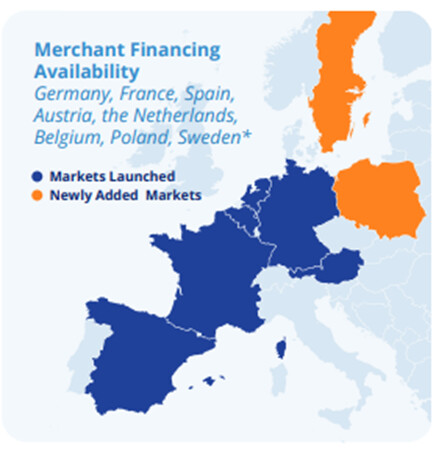
Merchant financing is being expanded to two new markets, Sweden and Poland, meaning margins will improve further through this in the future.

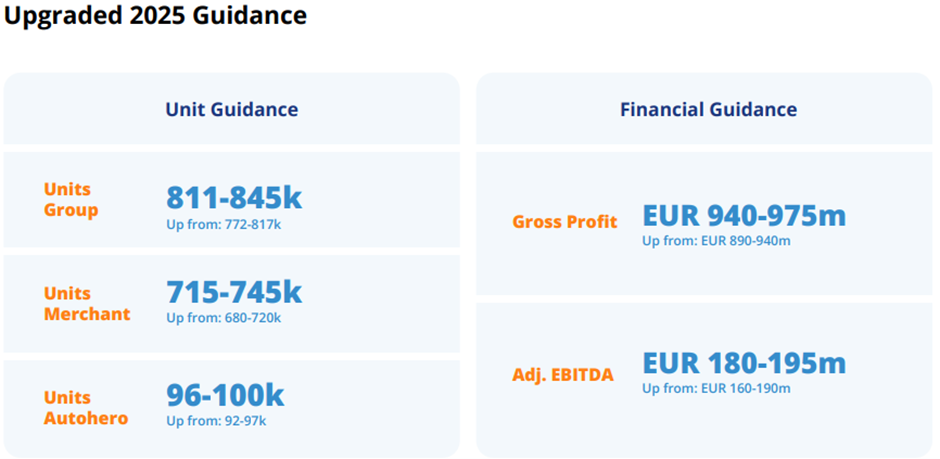
The traditionally cautious guidance at the beginning of the year has already changed a couple of times during the year, and now the upper end of the forecasts made after Q2 is roughly the lower end of the new forecasts.

I am now mainly swing trading here, for which this company’s stock performance is otherwise perfectly suited, but it certainly seems to have very good ingredients for long-term growth as well.

By the way, at the beginning of the year, I played analyst and wrote the following:

As things stand, no need to change the target price. :grin:

5 Likes

Updated target price views are now slowly starting to come in. Some of these, however, were already raised before the earnings report. I will review these over the next few days and add them as they are updated.

06.11.2025:

  • JP Morgan: 40 → 40 €, buy recommendation maintained (raised from 35 → 40 € on 03.10.)
  • UBS: 34.6 → 36 €, buy recommendation maintained.
  • Deutsche Bank 37 → 37 €, buy recommendation maintained (raised from 32 → 37 € on 23.10.)

07.11.2025:

  • Goldman Sachs: 36 → 37 €, buy recommendation maintained.

17.11.2025:

  • Barclays: 30 → 39 €, buy recommendation.

This quarter’s updates might be all for now. Regarding the updated target prices, the average settled at €37.8, which would represent an upside of approximately 50% from the current levels of €25.

5 Likes

@Kultapossu1 the stock development has indeed been surprising after the earnings report. However, the trading volume has been small, so it can easily distort if someone wants to sell a larger block. Have you noticed anything that would explain the share price drop? Has this happened before, right after a good earnings report, if I recall correctly?

1 Like

I’ve had to wonder the same thing a bit, because I once again invested more money in the company after a good earnings report. The stock last fell to the 200 EMA in the aftermath of Liberation Day, pulled down by the DAX. Now we are almost in the same situation, even though the DAX is still pulling near its peaks, and the company has not flagged any growth limitations.

It’s good that you asked, because I only now found the time to listen to the Q3 webcast and go through the numbers thoughtfully. The Q&A is still unlistened, but my own feeling was that, in summary, everything is growing (sales volumes, GPUs, merchant buyers, forecasts, cash), everything is being expanded (Refurbishing centers, drop-off points, countries included in merchant financing), and the only thing shrinking is delivery times. In the long term, things are progressing as planned and still faster than the general market.

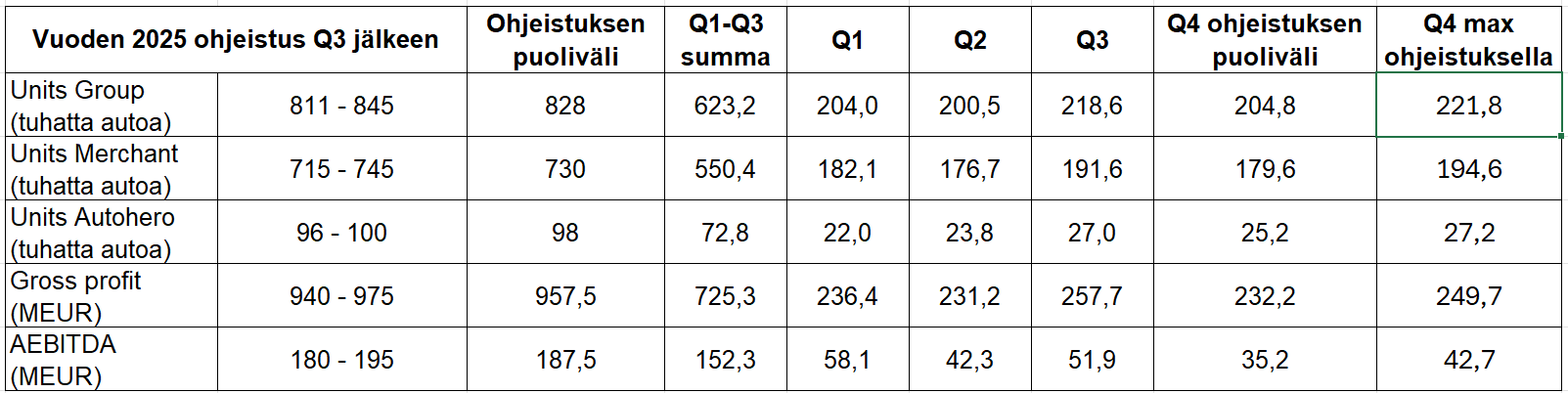
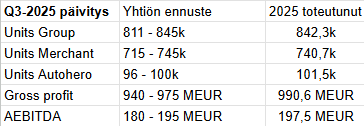
Since Q3 was so strong and we are now generally in a seasonally weaker Q4, as they always remind us, not very high expectations have been placed on the next quarter. Things in the market are rarely binary, but my best guess for the drop is the short-term guidance, which unfortunately I only now went through thoughtfully. Since they gave new guidance for the end of the year, their expectations for Q4 can be calculated from it, as shown below.

From the table above, it can be seen that when the sum of Q1-Q3 is subtracted from the midpoint of the full-year guidance, the result is a rather mediocre Q4 in relation to previous quarters. The best possible Q4 enabled by the guidance would be quite good, but it is probably not priced into the stock at the moment. Even that midpoint guidance is not particularly bad, but it looks like a clear weakening next to Q3, even though it is just short-term seasonality, not a weakness of the company.

Q4 seems to be quite a hit or miss for the company, with dealers reducing their purchases and consumers celebrating holidays. Traditionally, Q4 has been considered the weakest quarter of the year, but last year they did things a little differently, and the result was practically the best quarter of the year. I wrote at the time that the previous seasonality Q1 ~ Q3 > Q2 > Q4 might no longer fully apply in the future. This year will show whether last year was an isolated case or if they have found a way to turn previous weakness into strength. The drop in the stock price is still unnecessarily dramatic, so perhaps there is general nervousness about the price level and the direction of the DAX. In my opinion, the company’s valuation has not detached from fundamentals, so personally, I would expect the drop to stop at the 200 EMA at the latest.

Edit:
One more thing caught my eye. In Q3 last year, “high single digits” growth was predicted for Merchant for 2025. Now Boser only promised “low to mid-teens” growth, because efforts are being put into Autohero’s growth. Autohero’s annual growth was predicted to be about 25 – 30%. However, Autohero’s predicted growth is in the same range as this year’s realized growth of just over 30%. Since Autohero sells significantly fewer cars than Merchant, its growth at the unit sales level is not enough to compensate for Merchant’s predicted slowdown.

Literally listening to the webcast, I interpreted a slight slowdown in company-level unit sales for next year. However, management has often been cautious in its forecasts, and they have repeatedly been raised as the year progresses, so no far-reaching conclusions should be drawn about next year yet. For me, next year’s biggest expectations and opportunities for positive surprise are focused on Autohero, now that its sales momentum has finally picked up.

Edit2: One more bear argument.
One of the analysts asked how management monitors the benefits derived from the money spent on marketing. He implied that Autohero’s approximately 25 – 30% growth comes at a rather high price.

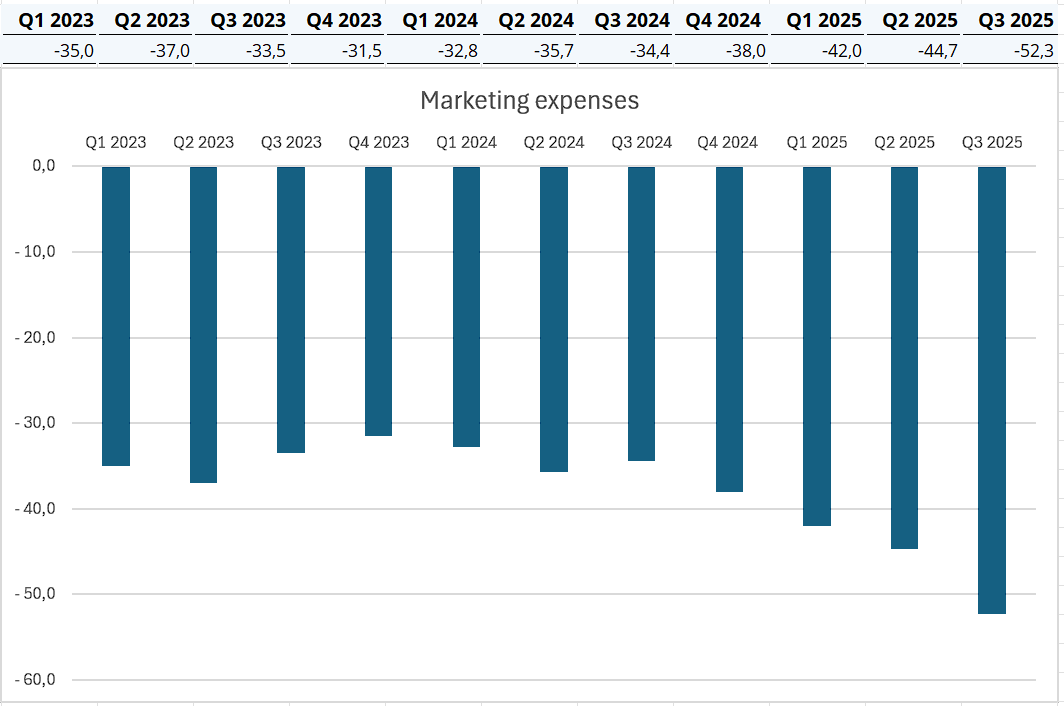
Before the CEO’s answer, here is my own background to the question and topic:

From the graph above, it can be seen that marketing expenses before Autohero’s scaling phase have been approximately 34 million euros per quarter. The current marketing investment of just over 50 million euros is, as I understand it, the level at which Autohero’s scaling is intended to gain momentum next year. Currently, about (52-34)*4 = 72 million euros are going into Autohero’s scaling annually, which is predicted to yield 25 – 30% growth, meaning about 30,000 new car sales through Autohero annually in the coming year. That translates to a marketing cost of 2400 euros per car sold. When Autohero’s GPU is 2664 euros, it’s no wonder if someone cautiously inquires about this.

According to the CEO, about 40 – 50% of the marketing carried out during the quarter directly impacts the quarter’s sales, and the remaining 50 – 60% is longer-term brand building. They are currently building the brand foundation and are satisfied with the current level. In response to this, I read between the lines that more AH growth might be coming, but they don’t want to commit to more at this stage. The 25 – 30% growth guidance is therefore characteristic of the company’s conservative approach.

7 Likes

https://ir.auto1-group.com/news/auto1-group-raises-inventory-financing-capacity-to-eur-16-billion-to-power-continued-growth/d491defb-6dd1-431e-ad80-f4690413d505

Auto1 is preparing for next year’s growth by increasing its “credit card” (inventory financing capacity) to EUR 1.6 billion. The previous level was about EUR 1.1 billion, which potentially threatened to become a bottleneck.

The press release mentions:

  • An increase in the number of banks providing credit (6 → 13)
  • The interest rate on the credit has been negotiated lower

Banks are therefore willing to lend more money at a lower interest rate, so I interpret the press release as net positive. As long as sales are strong and car prices do not significantly fall, the change will remain positive in the future.

4 Likes

Stock performance has been weak recently, but at the same time, analysts are raising their target prices; this week saw two forecast upgrades:

IMG_3116

2 Likes

AI-powered damage analysis of car exteriors has apparently worked very well at the test facility, as its use has been expanded to five of Europe’s 12 service centers. The remaining 7 centers are expected to implement it during 2026.

https://ir.auto1-group.com/news/auto1-group-scales-ai-powered-damage-detection-to-five-production-centers-enhancing-quality-and-efficiency/b0d603a3-4637-46b0-be8a-94463310e747

4 Likes

This is a good example of how AI is permeating sector after sector, increasing productivity. It’s easy to imagine how much human labor is saved and better quality is achieved. At the same time, such solutions strengthen my own investment thesis regarding Auto1 - size and economies of scale continuously bring a competitive advantage against small players whose ability, expertise, and resources to invest in such applications are limited. The industry will consolidate, and presumably a few large players will dominate the market. And Kamux will not be one of them :smiling_face_with_sunglasses:

2 Likes

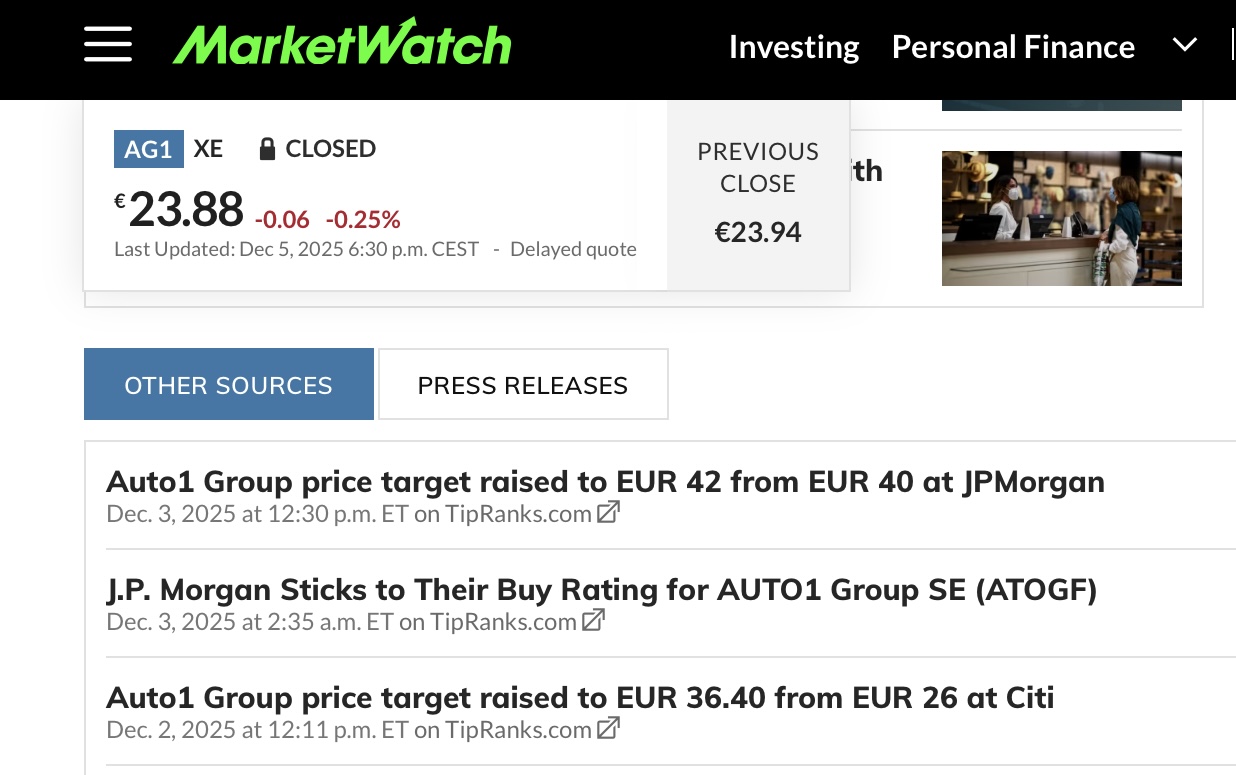
The background for today’s rise of over 5%. A Goldman Sachs analyst has raised the price target for Auto1 from 37 to 39 euros in a quarterly outlook, believing that growth and the capturing of market share will continue.

https://www.marketscreener.com/news/auto1-in-demand-goldman-sachs-sets-high-price-target-ce7e59d2d088f525

Expert Tate from Goldman Sachs wrote in a quarterly outlook for the fourth business quarter, available on Friday, that he expected Autohero, the trading platform, to post sales figures above consensus and targets. He emphasized that the outlook for Auto1 in 2026 was promising, with the company apparently continuing to gain market share. Autohero is quickly reaching the desired scale in an attractive market environment that only has room for one winner.

4 Likes

Target price updates spotted on the Marketscreener site. Previous recommendations have largely been reiterated, but there are the following more detailed comments + a change:

US investment bank Goldman Sachs has maintained its “Buy” rating on Auto1, keeping the price target at 39 euros after Aramis released its quarterly figures. Analyst James Tate wrote on Tuesday evening that his expectations for the German online car dealer’s upcoming quarterly report remain unchanged. He anticipates positive surprises. Aramis achieved solid sales volumes in its key overlapping markets – particularly France and Spain – despite challenging market conditions./ag/ck

US bank JPMorgan has raised its price target for Auto1 from 42 to 50 euros, maintaining its “Overweight” rating. Analyst Marcus Diebel also assigned the online car dealer’s shares a “Positive Catalyst Watch” ahead of its earnings release at the end of February. He expects a strong close to the year 2025 and has also raised his operating profit estimates for 2026 and 2027./rob/ag/gl

3 Likes

We are currently living through an Auto1 investor’s “dream month”: a 25% drop without any significant events or news. I have continued lowering my average price, but the direction should change soon or I’ll run out of liquidity. Feel free to come rescue me from an Auto1 bankruptcy if you have identified the factor explaining this drop. Something is being revalued here, but I haven’t managed to find any single factor. Below are my own observations.

Recent News:

The larger banks have kept their buy ratings and price targets unchanged, but according to a mini-news item, the small Dr. Kalliwoda Research has initiated coverage with a sell rating. I couldn’t find any more news on this, and even AI didn’t have access to it. The news is odd in that it also cannot be found among the latest analyses on Dr. Kalliwoda’s own website. Since I haven’t seen the report, it’s difficult to comment on its impact on the stock price development.

If you have followed the markets at all in recent weeks, you know that AI fears have wreaked havoc on software company valuations. For some reason, these fears have also been linked to Auto1 in the news (1), (2). I don’t really know if this can be the root cause either, and if it is, I suspect the baby is being thrown out with the bathwater. I find the fear strange because, for well-founded reasons, Auto1 is more than just a software firm.

Yes, in the future, someone could “vibe-code” software with desired parameters that scans cars from the internet and attempts to estimate the car’s condition and history based on images and registration data, as well as secure financing for the buyer. This could certainly be done with significantly less personnel and infrastructure.

However, “tire kicking” has long been one of the final frontiers that online sales haven’t managed to disrupt. As I see it, this is due to the inherent lack of trust between buyer and seller: in car deals, the buyer fundamentally believes the seller is trying to hide defects or at least suspects the seller will conveniently forget to mention them, as the seller has a financial incentive to do so. Software alone is not enough to bridge this trust gap. Beyond software and financing, Auto1 still has a 1.6 billion euro car inventory and an annual reconditioning capacity of 250,000 cars, where cars are photographed and appraised with AI assistance. During reconditioning, mechanics read the car’s fault codes, check dozens of different parameters of the car’s condition, and repair defects if necessary. All of this is documented and presented to the potential buyer. After that, Auto1 has a network of over 600 drop-off points and the transport capacity to move the car to the customer in less than ten days in most of Europe. After the car is delivered, the customer still has a warranty, the option to return the car, and get their money back. Building the trust necessary for a transaction in online car sales requires sufficient transparency, as with every new buyer, trust can only be lost once.

In addition, Auto1 is surely one of the most AI-positive car dealers, already integrating many AI-enabled features into its software (90% automated pricing, car buying and selling leads, part of customer service). In practice, the company aims to use AI to industrialize the components required for building trust.

In light of recent market events, I could well believe this is one reason behind the depressing stock price development. If online car software starts being built with the help of AI, this could in principle have a margin-eroding effect on Auto1.

A third risk could relate to fears about the adequacy of free cash flow at a time when the company is trying to grow its car inventory while used car prices are falling in Europe. The company has just raised its “credit card limit” to 1.6 billion euros with next year’s growth in mind, but in the latest January price index, it signaled that prices have dropped, albeit still moderately, by 1.2% month-over-month. In the same publication, however, half of the dealers believe the price drop will continue as the year progresses.

The company has substantial cash reserves mainly because they can transfer consumer loans to banks with a 95% financing rate. ABS (Asset-Backed Securities), on the other hand, covers the price of a purchased car with an 81.25% financing rate—meaning when the company buys a car for 10,000 euros, it only has 1,875 euros of its own money tied up in it after ABS financing, and the remaining 8,125 euros of the purchase price is freed back into the company’s cash reserves. I understand this as the company having essentially found a way to have banks pay for 80-95% of its growth, and the partnership works as long as its margins hold. One reason for the 81.25% financing rate is surely the use of the company’s own reconditioning centers, which cannot be replicated by vibe-coding either. Banks trust the company’s car inspection and reconditioning processes and therefore dare to finance the majority of its car inventory.

However, price fluctuations are part of the used car business, and as I understand it, the company keeps its cash reserves high to prepare specifically for price drops, or practically a collapse, and the resulting problems with bank financing. For this reason, I also don’t believe the company will use its cash reserves for inorganic acquisitions in the near future, as it serves as a backstop for the financing instruments used.

Thus, the outfit likely aims to continue growing its cash buffer in proportion to the growth of ABS financing and car loans. One possibility is that there is a revaluation, at least momentarily, regarding a decoupling from this connection as a result of continued price declines. This is apparently a conflict between the cash shown in reports and accounting FCF, but that deserves its own message if I ever find the time to understand it properly. Feel free to explain it to me in layman’s terms.

In practice, the share price started its final downward slide exactly on the day the price index was published (Jan 28th), so based on circumstantial evidence, this is one smoking gun.

As can be inferred from the stock price, the rubber band is stretched quite tight heading into the next quarterly report. A good result will (hopefully) be rewarded, and the outlook for the coming year will certainly be under the magnifying glass. Weaker results are hopefully already mostly priced in by now, but unfortunately, the times have proven to be quite unpredictable.

5 Likes

When considering Auto1’s Europe-wide network of sellers and buyers, brand recognition, extensive car maintenance infrastructure, and the ability to broker both partner and internal financing, I don’t believe the market is particularly worried about vibe-coding or AI agents in this story. Rather, I believe it is autonomous cars and the resulting shift in the need to own a car that the market is nervous about.

I have been following the discussion around Carvana to some extent, and there, the sell-side is now pitching them as well-positioned for the AV (autonomous vehicle) transition, as they are capable of managing a large AV fleet through their network and thus adapting as the business environment changes. On the surface, it’s hard to see why the same wouldn’t apply to Auto1 (and additionally, Europe is clearly behind in AV adoption), but I haven’t observed a similar narrative shift in discussions around Auto1.

These narratives can drive stock prices for a surprisingly long time, and the direction can change drastically when the market starts to look at the stock from a new perspective.

6 Likes

Q4 Trading update, Press release and Excel figures have been published.

Based on a quick scan, it didn’t disappoint this time either; it’s steaming ahead. :partying_face:
In my opinion, the stock should react positively to these results, but we’ll see, given the current times.

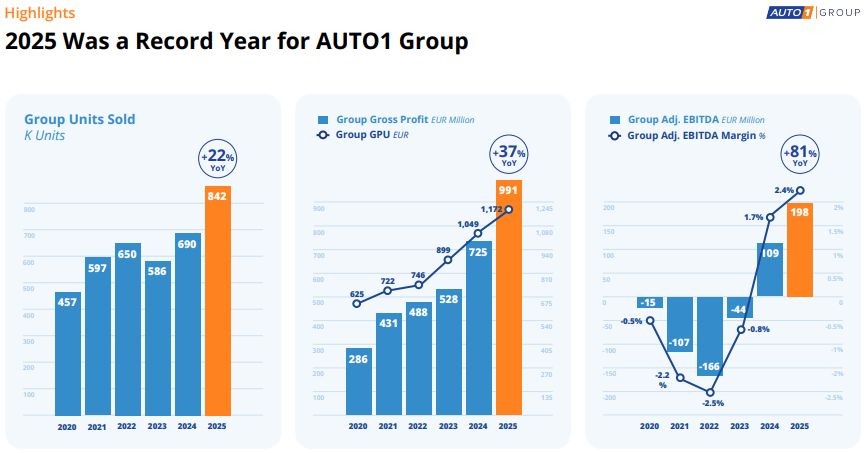
Full year compared to previous years.

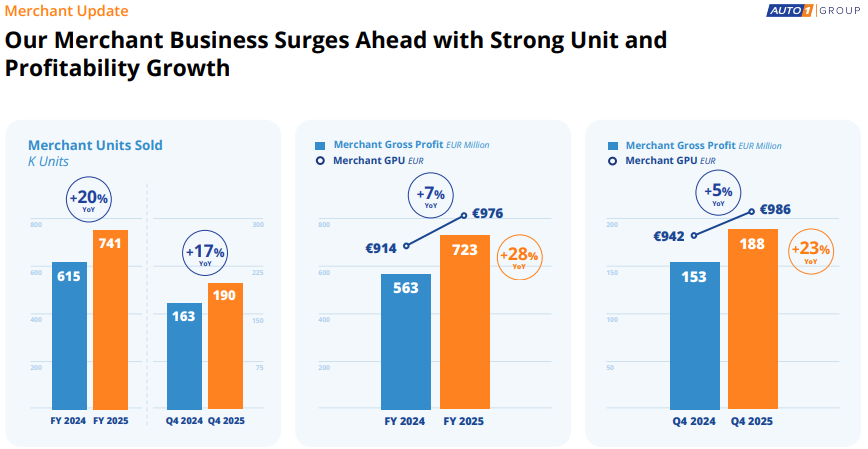
The already profitable Merchant segment continues to grow:

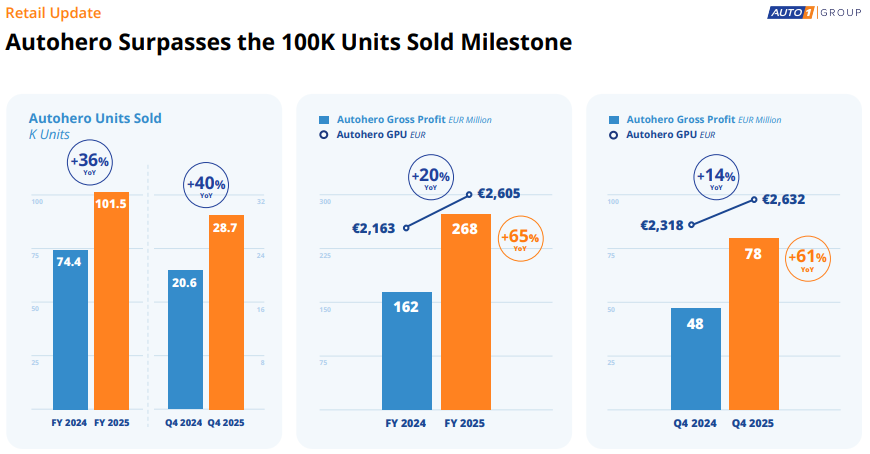
And this was important: Autohero is growing even faster, as it should with these investments. Sales exceeded 100k cars for the first time.

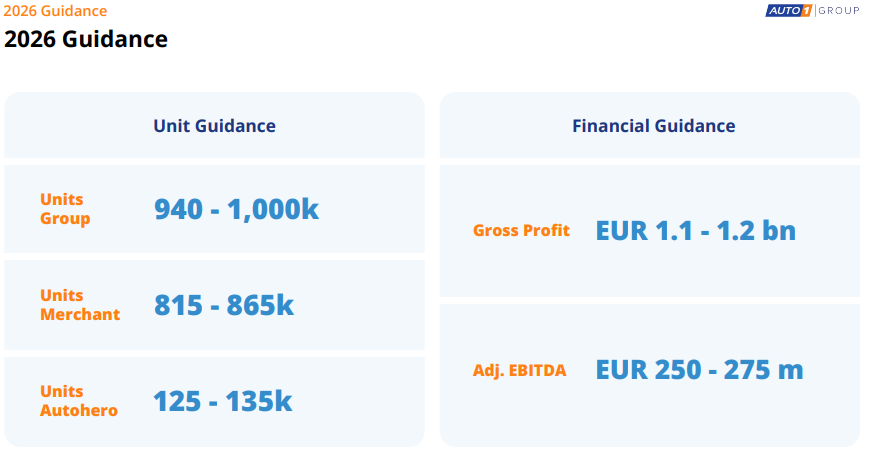
2026 guidance:

The company is traditionally a conservative guider. Based on these figures, growth would be projected at Units Group +15.2%, Units Merchant +13.4%, and Units Autohero +28.1%.

4 Likes

It’s looking good indeed. Marketscreener’s pre-market is currently showing a gain of about 6 percent. The stock price has fallen so sharply since the start of the year that it’s hard to see the value decreasing further with a report like that.

2 Likes

Record results and -10% on the board after the first 15 minutes.

This is what happens when you start giving cautious guidance…

3 Likes

The company has always issued cautious guidance, and we’ve often seen choppy movement after the report. The final price action has only been seen afterwards. This was already the second good fourth quarter in a row in a quarter generally considered weak. It seems they have indeed found ways to turn a seasonally weak quarter into a better one.

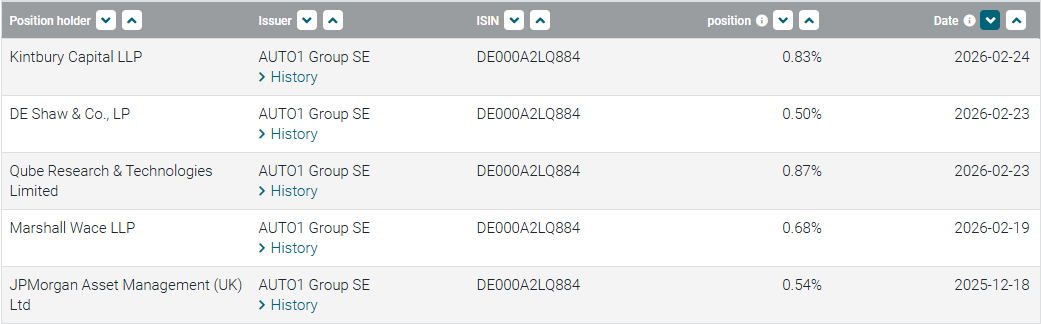
I think there’s more to this than just the guidance. I haven’t followed the company’s short interest before, but since the beginning of the year, positions of at least 0.5% have been taken totaling 2.88%. The share price decline started at the same time as Carvana.

3 Likes