Analysis of all Inderes recommendations

A few examples of typical Inderes stocks and their recommendations

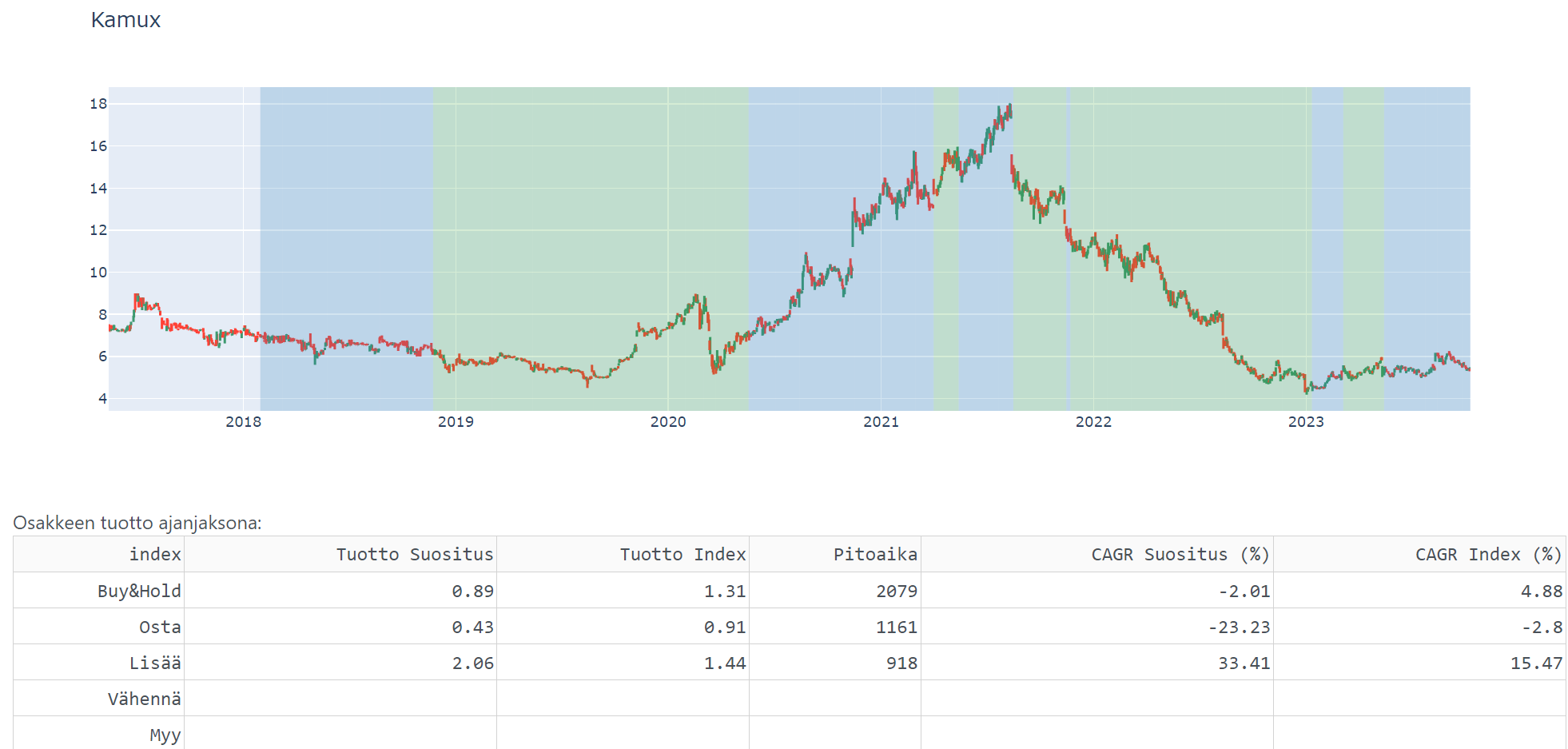
Kamux: always recommended to accumulate, doesn’t work if the stock doesn’t rise, a buy recommendation into a big drop…
image

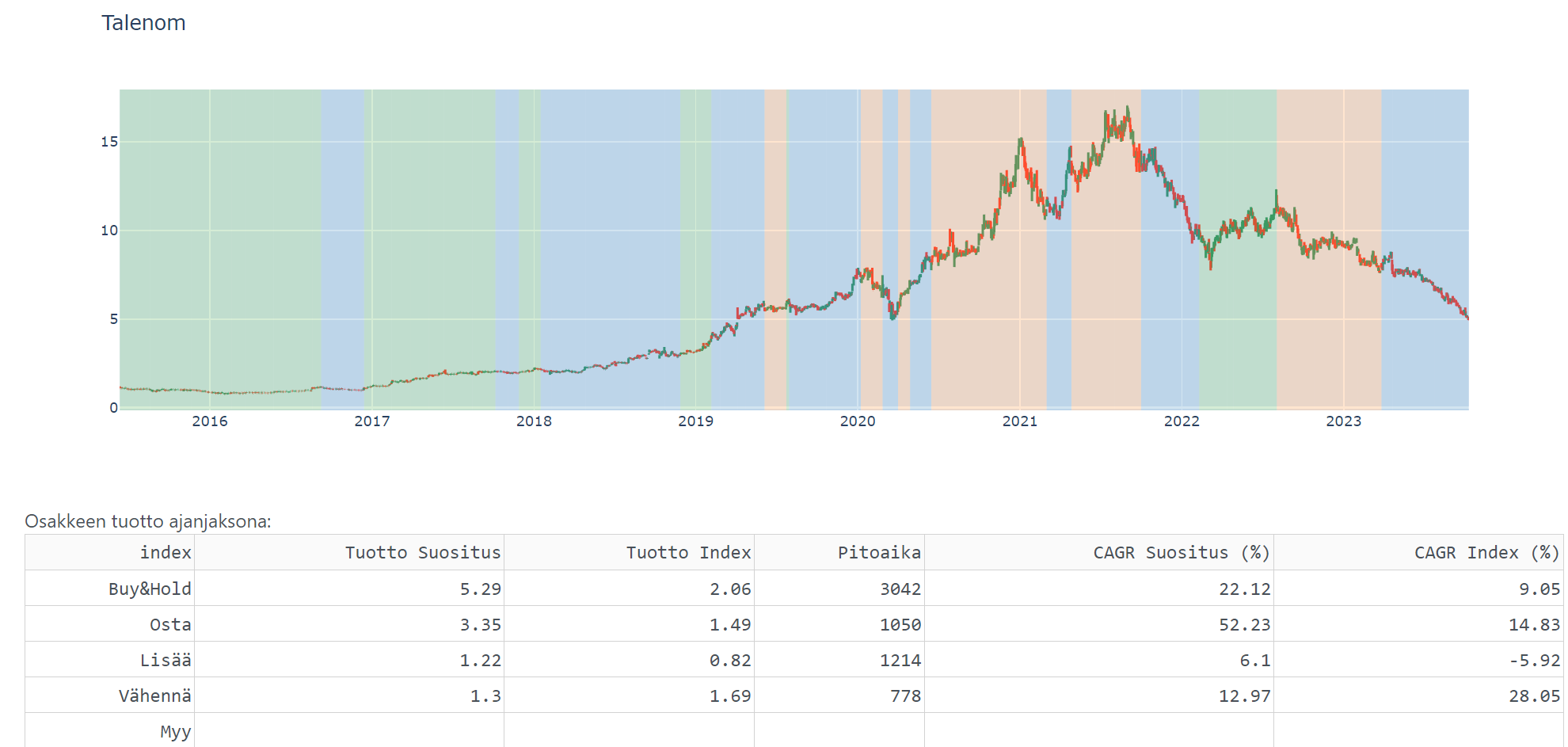
Talenom: stayed on board well here, made some harmless “reduce” recommendations, although also accumulated during the decline…
image

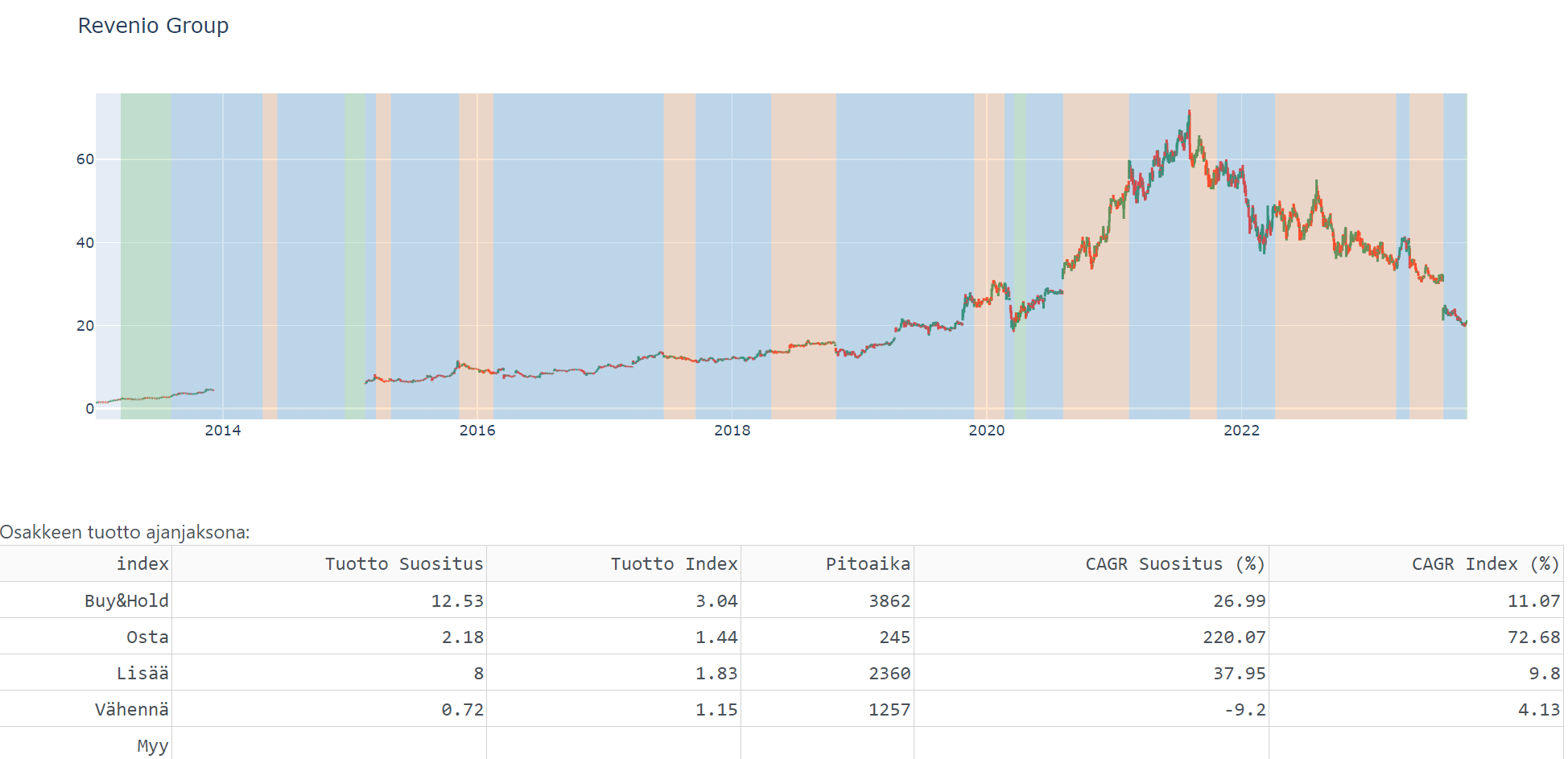
Revenio: here all the recommendations hit the mark…
image

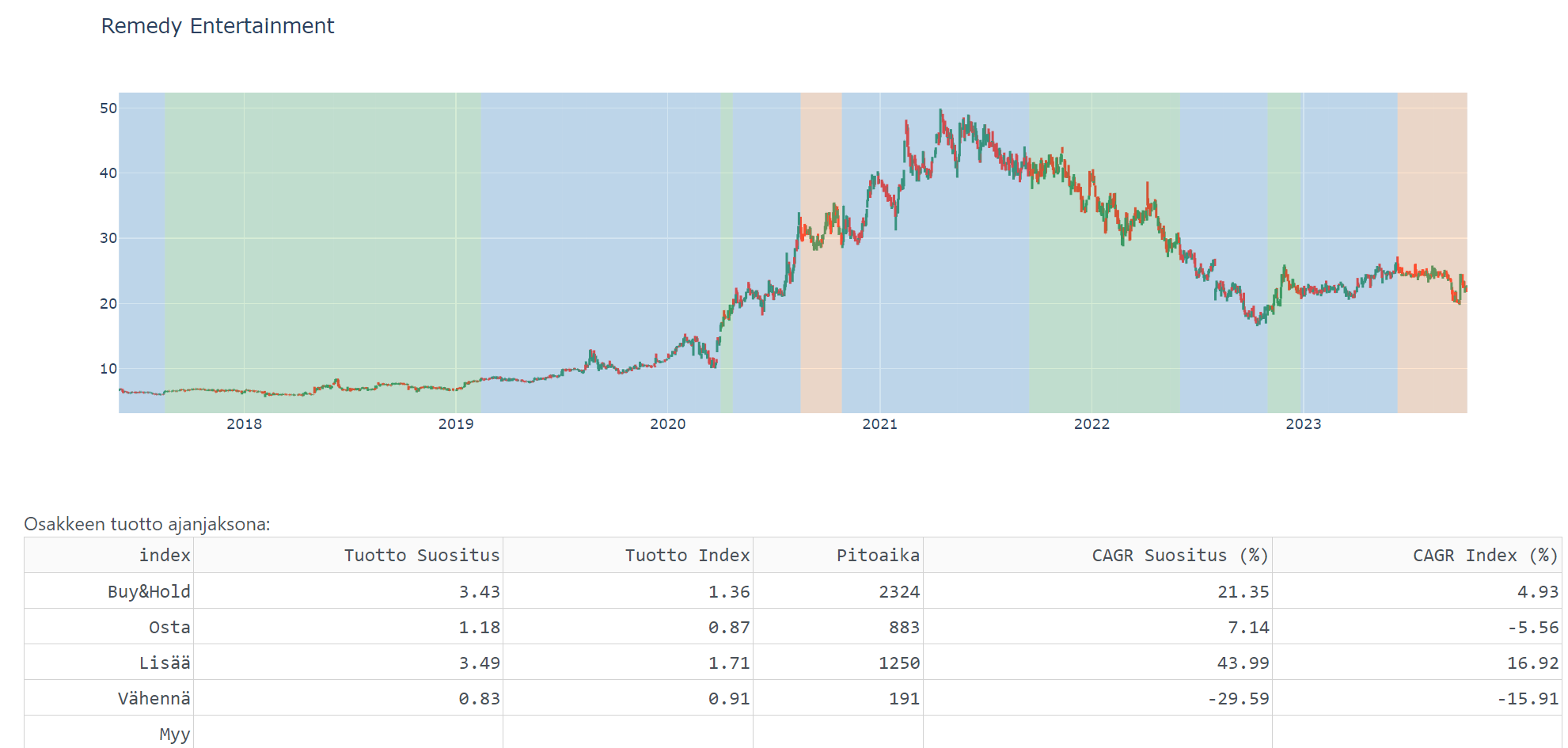
Remedy: stayed on board well and reduced, although also bought and accumulated during the decline
image

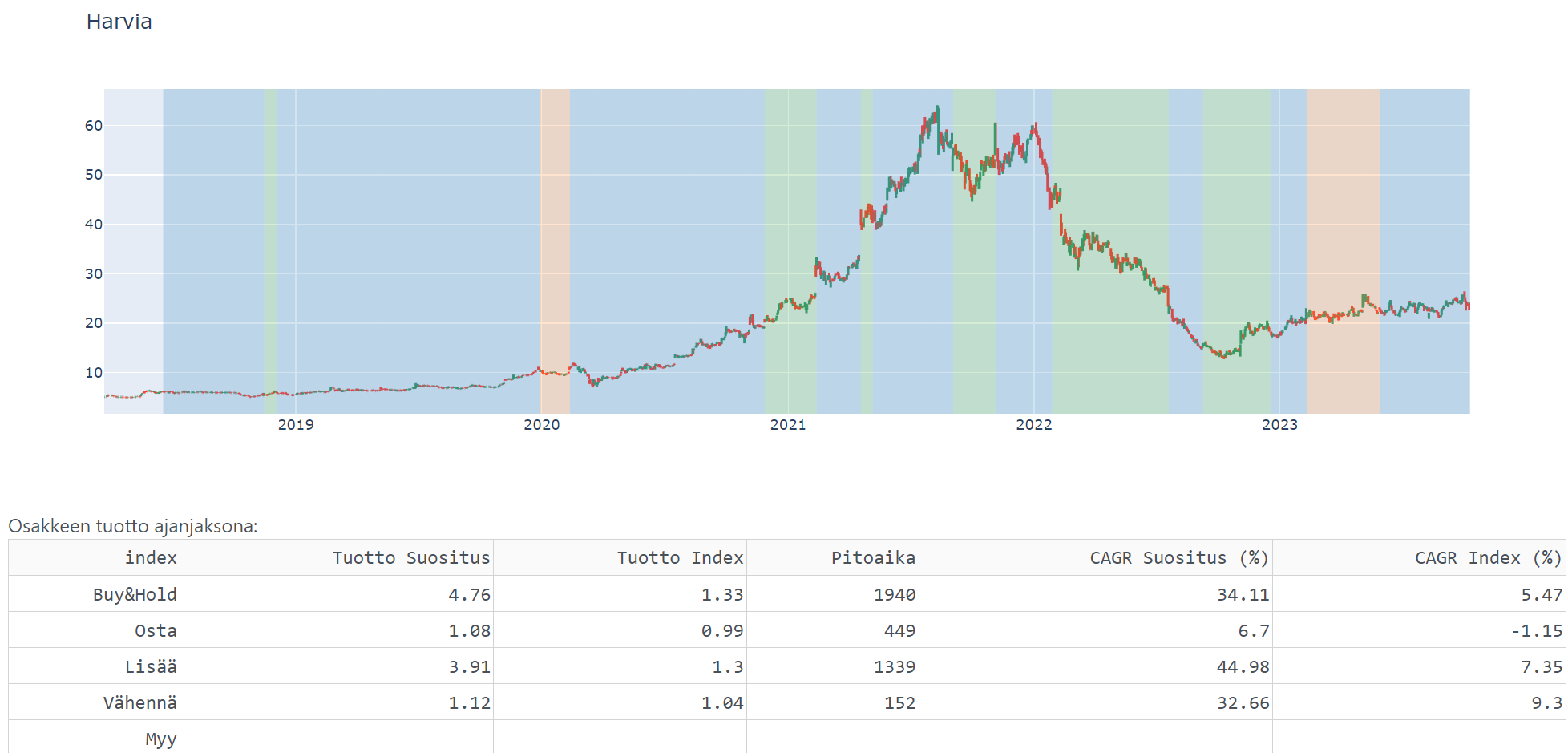
Harvia: stayed on board well, a couple of unnecessary “reduce” recommendations, although one “buy” at a bad time…
image

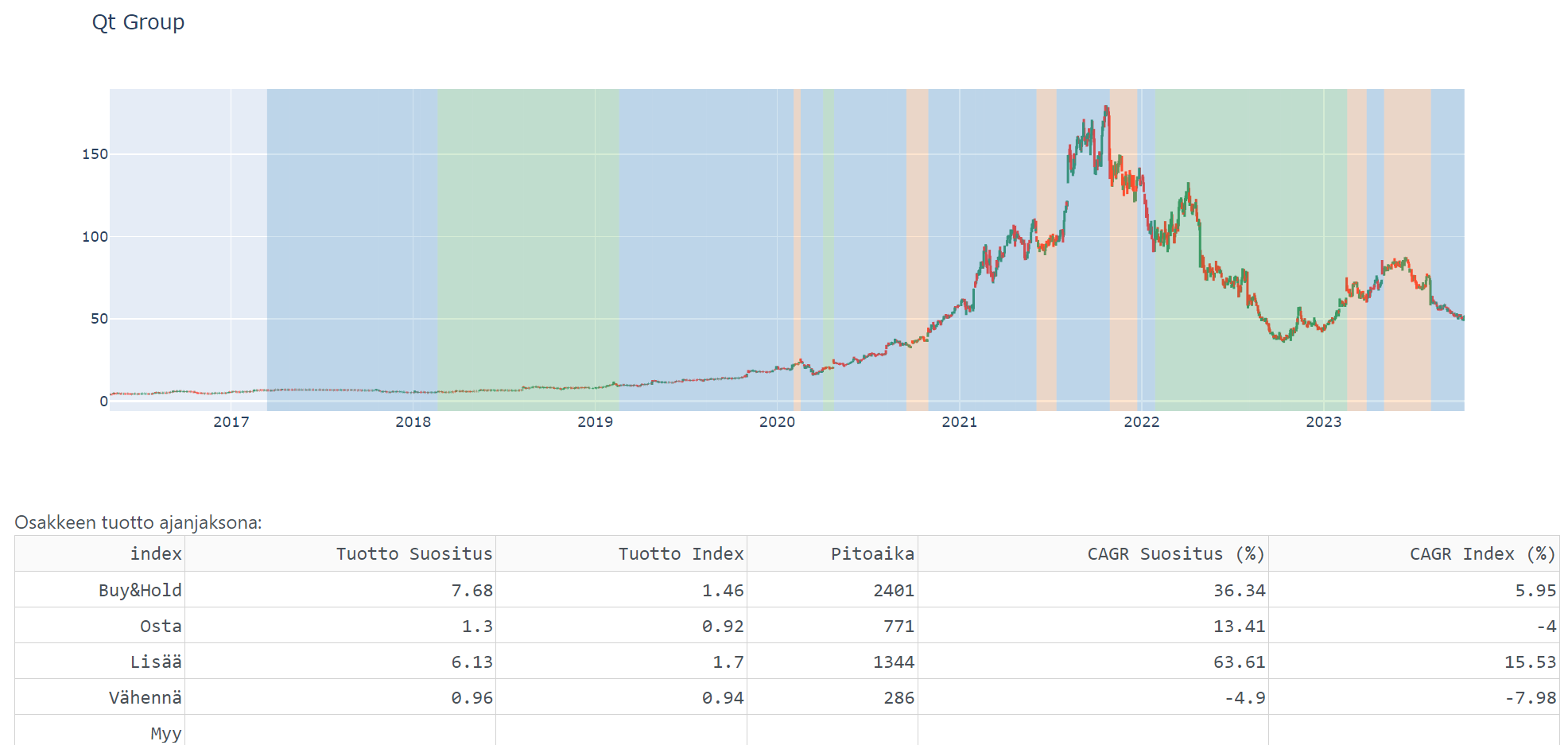
Qt: stayed on board well, a couple of good “reduce” recommendations, although one “buy” again at a bad time…
image

The 2022 decline and the buy recommendations at that time for many of the forum’s star stocks :harviaraketti: have likely stuck in the minds of private investors. One performed quite okay in these if they were involved from the start, though I suspect many only joined when the ride was already well underway upwards and ended up at a loss.

17 Likes

Could we get a legend for the colors? Mainly green and blue.

4 Likes

Green buy, blue add.

Hi @vuh, have you updated your statistics for 2024, as things have been a bit quieter on the Finnish stock market?

10 Likes

Which other research providers do you actively follow besides Inderes? (primarily the Finnish market) Personally, I follow OP’s ideas and their morning report.

How do you usually compare recommendations with each other? My own idea is to go through the recommendations once a week, making notes and drawing conclusions.

1 Like

Hi!
I have a question regarding those target prices and “buy, sell, add, hold, etc.” recommendations: what is the timeframe they are given for? In other words, if Inderes gives stock X a target price of 10€, what is the time horizon it is aiming for?
It just occurred to me that since there are many different companies and their development varies greatly, do they all have the same timeframe for the target price?

1 Like

Hi @Jauru,

All Inderes target prices are given for a 12-month horizon, so the time period is not changed on a company-specific basis :smiling_face:

Weekend greetings,
Johannes S.

8 Likes

Thanks for the quick response and have a great weekend!

2 Likes

This has probably been covered and clarified during the forum’s history, but at least for me, it is still quite an open matter.

So, do the analyst and the company keep in touch between interim reports? Does Inderes have a general policy on this, or does it depend on the analyst, the company, or the specific analyst & company pair? If there is interaction, does the initiative always/typically come from the analyst or the company?

Thanks in advance for any possible clarification!

PS. To clarify further, the question concerns interaction beyond any potential publicly announced “analyst meetings” held by the company.

Regards, Postimies

2 Likes

Cognitive Bias - In Me, In the Analysis, or Not at All?

A seed of doubt arose when I paid attention to the recommendations for the companies I follow on Inderes. I follow 24 stocks on Inderes. These have accumulated over the years, and additions or removals are rare; the vast majority of companies have been on my watchlist for over a year.

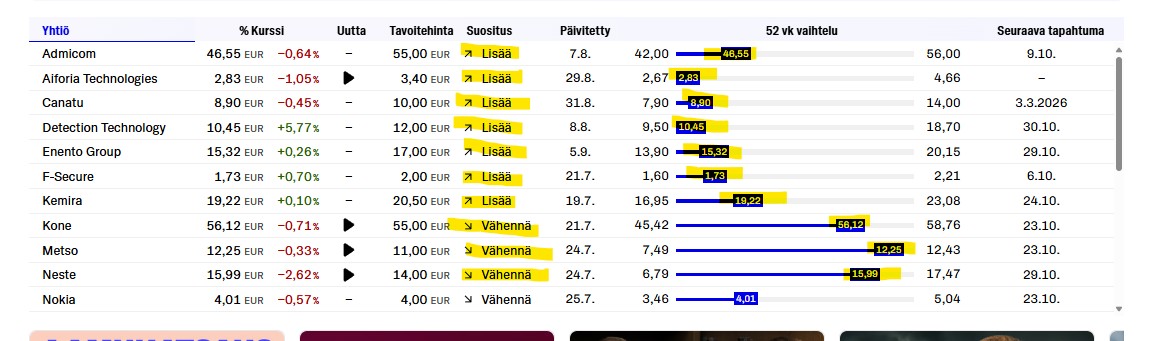
Inderes’ general overview shows the stock’s 52-week price range. I don’t normally pay attention to this when I determine a stock to be “cheap” or “expensive” based on entirely different criteria than how its price has fluctuated during the year. That’s why I was a bit surprised, as this metric is not something I follow or consider significant, that with strong emphasis:

  • A stock whose price is below its 52-week average receives an “add” or “buy” recommendation.
  • Stocks that are above their 52-week average predominantly receive a “reduce” or “sell” recommendation.

Out of the 24 stocks I follow, only 4 behave differently from this pattern. Delving into analyses and fundamentals feels a bit pointless if there’s a cognitive bias that would allow one to identify whether a stock belongs in the “buy” or “sell” category just by glancing at the 52-week price range – and be right with a high probability :).

This could absolutely be pure coincidence – no scientific study can be built on a single data point (this day and these units), but just for Saturday’s entertainment, I asked AI about bias in general terms:

Gambler’s fallacy (the belief that “a series must even out”) and hot-hand fallacy (the belief that “a streak will continue”) are well-known cognitive distortions. At the roulette table, after a series of reds, some of us tend to believe that red is “hot,” and some tend to believe that the series must break and it’s worth betting on black.

Mechanically random processes (roulette): people statistically bet “against” more often after a long streak → gambler’s fallacy dominates. In field observations at roulette tables, after a streak of 5–6 of the same color, up to ~85% of bets were against the streak.

Human performance (sports): the belief in continuation is more common (hot-hand). A classic basketball study long claimed that there was no “hot hand,” but a later statistical correction shows a small but real positive correlation.

Stock markets: both are visible in the data – but on different timescales. Based on investment data, continuation (momentum) is on average “stronger” over a 3–12 month horizon; reversal is emphasized over very short and long timeframes.

How do Inderes’ analysts identify potential cognitive biases? The analysis surely relies on various facts and statistical methods, so that final touch in a borderline case – do I lean towards “add” or “reduce” when one must be chosen – is this perhaps unconsciously influencing the thinking in the background?

Have a nice weekend everyone!

Stocks I follow: Detection Technology, Talenom, Orion, F-Secure, Terveystalo, Enento Group, Kemira, SRV Group, Sampo, UPM-Kymmene, Metso, Valmet, Canatu, Wärtsilä, Nokia, Admicom, Nokian Tyres, Kone, Aiforia Technologies, Qt Group, Tietoevry, Remedy Entertainment, Neste, Witted Megacorp
22 Likes

Greetings Mailman,

I’ll try to answer your question. These are more my own experiences and loose thoughts.

Basically, yes, naturally outside the silent period. However, it really depends a lot on the company, the news flow, industry events, potentially relevant macro movements (this year, for example, tariffs), and generally whether there are any unclear matters. I personally try to call the company with a relatively low threshold if there’s a reason. There aren’t many calls per company, but probably a few during a quarter. Sometimes more, sometimes less. But if nothing happens, I don’t just call for updates. In that case, we might only talk on earnings days, but some kind of pre-silent period discussion is, in my opinion, part of it. Not everyone arranges these separately, especially if there’s only one analyst.

It also depends to some extent on the company, its management, and the analyst & management pair. With some, there’s a better relationship, allowing the CEO to also act as a kind of “industry expert”. Then we can discuss the general industry situation or ask for comments on, for example, a competitor’s acquisition / strategic move, even if there’s no direct connection to that specific company. Fundamentally, CEOs are busy, so if they spend time on such matters, the analyst must also have something to contribute to the discussion. In that case, it can benefit both parties, even if it doesn’t directly relate to the analysis of that company.

Usually, the initiative comes from the analyst, but sometimes companies also call. Company calls might be related to wanting to deepen understanding or correct potential misunderstandings. That is, a report or comment related to the company has been read, and they want to clarify their own view on the matter. And sometimes, rarely, there’s also criticism when their view on the matter is different – then we discuss, and hopefully, both learn something from it.

In addition to calls, there are, of course, company visits, factory visits, trade fairs, and sometimes other events. Often, these have more visitors, and then the invitation comes from the company. But after an interview with the CEO, we can go on a factory tour to kick the tires without a larger group. These aren’t usually very frequent, but companies do appreciate it when we visit them sometimes, and not always the other way around. Especially those not in the Helsinki metropolitan area where “natural” visits are less common. But whenever we visit, we must also be well-prepared. One must respect others’ time.

To my knowledge, Inderes doesn’t have a general policy, but activity is encouraged. As I went through above, there are many variables, making it impossible to state a “correct” policy for all companies. Fundamentally, every discussion and visit teaches something new, making interaction with the company and its management highly desirable.

I think all questions have been addressed; I hope this clarified the matter!

30 Likes

This is not directly related to Inderes’ analysis, but to analysis of analyses, however. I couldn’t quickly find a better thread.

A teammate had written a master’s thesis on how public recommendations affect stock prices. In his own research, he focused on a Dutch TV program and the Dutch stock exchange.

However, the literature review of the thesis is broader and contains quite interesting information.

A few observations:

  • The effect is usually short-term
  • The effect is greater for small companies
  • Non-paid analysis has a stronger impact.

There were also some other observations, for example, about the distribution of recommendations being more positive.

Thesis - Sven Cruchten.pdf (1.5 MB)

For some reason, around here, goalkeepers in particular seem to be interested in investing.

10 Likes

By the way, what is the ratio of Inderes’ Buy/Accumulate vs. Reduce/Sell recommendations?

It just occurred to me that the average stock (median) produces a loss in the long run. Recommendations should clearly reflect the fact that only a minority of stocks even turn a profit, let alone beat, say, the risk-free interest rate, etc. In fact, a very small group of stocks generates the majority of the returns.

In other words, the majority of recommendations should be Sell/Reduce and a smaller portion should be Buy/Accumulate. (At least if we consider a recommendation that is useful from the investor’s perspective.)

Edit: Especially Buy recommendations should be rare.

2 Likes

Surely not the big companies, right? I suppose one should consider the ratio of large companies vs. small companies vs. startups (most of which will go bankrupt), I wonder what the definition of a startup is. Does, for example, Aiforia meet it?

This phenomenon doesn’t really stand out yet on a one-year time horizon, which is the timeframe for which recommendations are given. Over such a short period, it should actually be fairly balanced.

2 Likes

If it were enough just to generate positive returns on average, a little under half of the recommendations should be positive. But if you were to beat even something like the risk-free rate, the share of positive recommendations on average would need to be significantly lower than half.

What I’m getting at is that the most useful investment recommendation for an investor would be one where a company’s excellence is identified, and then you just repeat the “buy” recommendation. When you consider that over 10% of the total stock market return over the last hundred years is explained by Apple and Nvidia alone (out of tens of thousands of companies), the return peak is very narrow.

In theory, there should be a “Buy+” recommendation for companies estimated to perform well over the very long term. In that case, a few well-chosen stocks that you would hold for a long time would be enough for an investor. Well, of course, no one has a crystal ball to be able to provide such recommendations. :smiley:

My point is that if you are aiming to even match the market return, positive recommendations should be a clear minority. If the recommendations are roughly split 50/50, their value to the investor is quite small; you’ll likely achieve a better result with an index fund than by following recommendations.

Don’t misunderstand my criticism – I think Inderes’ analyses are good in themselves and explain companies well from an investor’s perspective. I would just like to see the ratio of positive vs. negative recommendations and mirror it against the observation of how small a group of companies actually outperforms the market (or generates positive returns at all).

5 Likes

There is something off about that logic. An index can also be thought of as recommendations where all companies are given a positive recommendation. And, as is well known, the index beats the risk-free rate in the long term. :upside_down_face:

It is simply a feature of the stock market that a large portion of the returns is generated by a small group of top-performing companies. Hitting those through stock picking and buy recommendations in analyses always requires luck, as there is no working crystal ball. The more knowledge and insight one has, the less luck one might need compared to those who lack such knowledge.

3 Likes

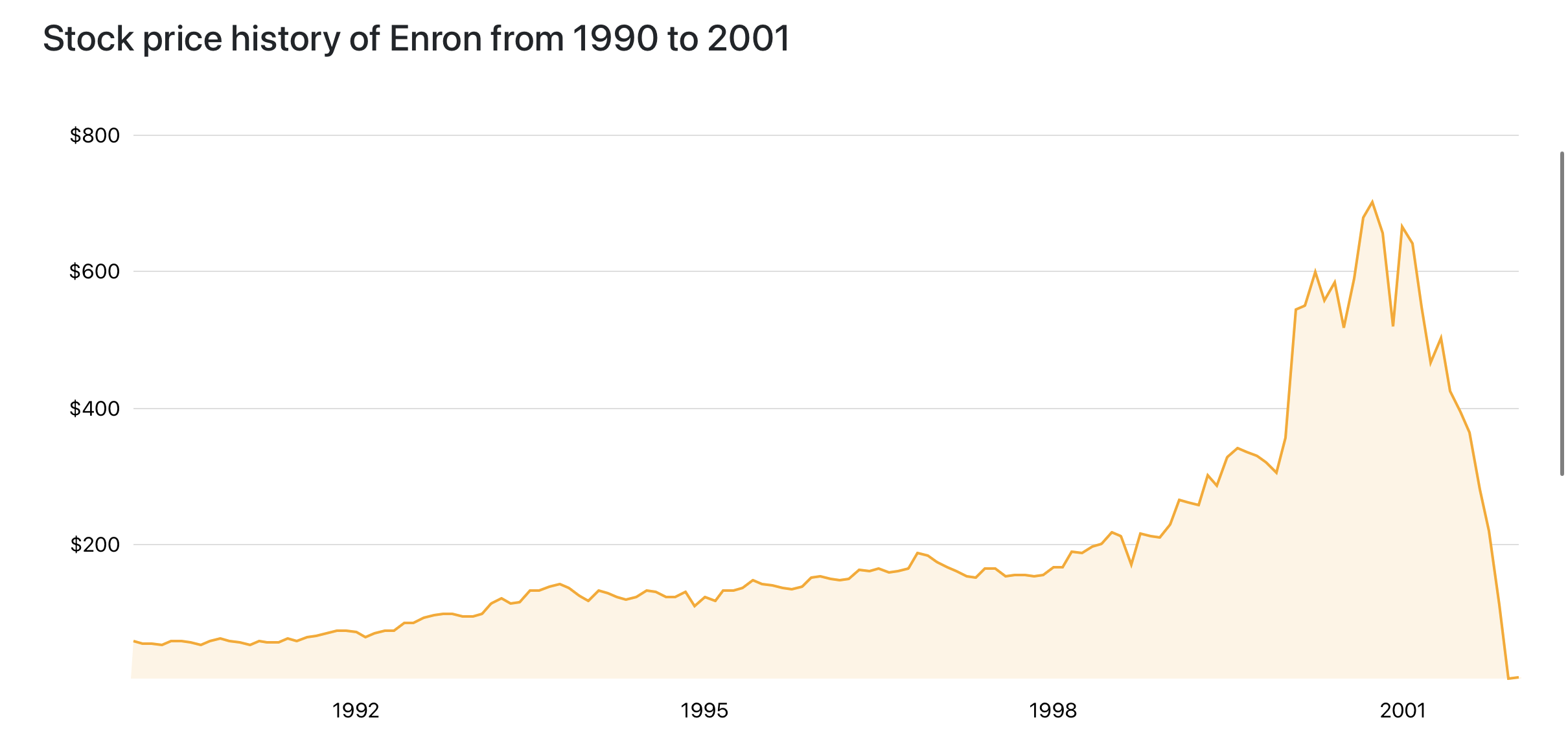
This is a fairly common logical fallacy that confuses a stock’s total return over an unrealistically long time frame with a stock’s return from an investor’s perspective. A typical investor owns a stock for at most a few years, and there is a significant number of stocks on the stock exchange that provide positive returns to investors over a holding period of a few years. For example, Enron was a clear “accumulate” or “buy” recommendation for almost its entire history, and owning it was profitable for investors, even though a “buy and hold forever” investor eventually lost absolutely everything. You can see this directly by looking at, for example, the company’s stock price chart over the last ten years:

If you intend to own a stock for 100 years, then the top of the returns is extremely narrow. If you own it for a few years, the top of the returns is quite broad. If you only own it for a day, you can potentially make a profit on any stock on the exchange. You can only make a profit or loss on the stocks that are in your portfolio and only for the time that they are held, so theoretical calculations with unrealistic holding periods should not be used to guide real-world actions. Inderes does not issue recommendations for “buy and hold forever” investors, but rather for about a year ahead, and with a one-year investment horizon, I understand that the vast majority of listed companies have a positive expected value. Few investors on this forum have ever owned or will ever own a single stock for even ten years.

23 Likes