It must also be remembered that this use of AI is actually only a phenomenon of the past few years. Old school folks are slowing down adoption, and cost savings are having to be made by others besides just Finns, which also slows down the adoption of new technology. Additional financial investments seem to be made right now in pathology and other healthcare sectors to increase AI and digitalization in Europe and elsewhere. Aiforia has already spread its tentacles to at least France, Italy, England, and whatever others there might be. It won’t be ready overnight and it takes nerves. You just have to believe in the company if you intend to invest, everyone makes their own decision whether to stay along or not. A year or two will probably show how this turns out in the end.
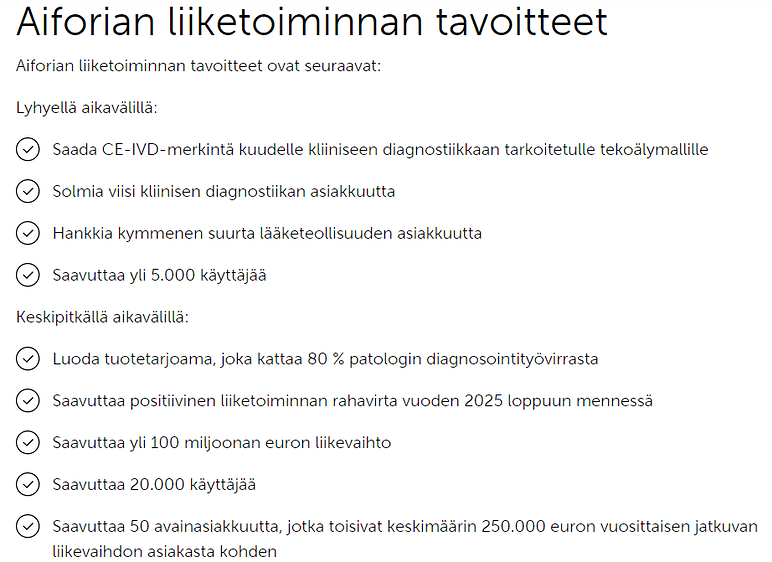
Five years ago, at the time of the IPO, the targets were tough. According to them, the company would now be cash flow positive (by 2025) and revenue would exceed 100 million euros, if five years is considered the medium term. In H1 2026, revenue collapsed to 753 thousand euros and cash is still being burned at an astounding rate. I would like an analysis from management on what has gone wrong and why we should still believe in the never-ending growth story.
Take a look at Nokia’s history just for fun. 1991 was Nokia’s worst year in the company’s history up to that point, and the company was close to being sold (copied from Wikipedia). The first NMT phone came out in 1987, the actual rise began starting in 1992, and then all hell broke loose. There are probably also those who have torn their hair out (repineet perseensä) regretting selling their Nokia shares in the early days. Now, I’m not claiming Aiforia is the new Nokia, but it also took time back then to develop into the biggest in its field + fall into mistakes afterwards. Maybe many think this is a far-fetched comparison, but back then too, some believed in the company and some thought it was nonsense—the same seems to continue for Nokia even now, the future will show for Aiforia as well. As Hugo the Troll (Hugo peikko) said back in the day, “You can’t always win, not even every time.”
So if
- H1/2026 revenue is approx. EUR 750k
- revenue is almost entirely from these AI analyses
- loss is EUR -7.5m
=> If the volume of analyses multiplies by 11, revenue will be EUR 8.25m, at which point the loss-making would stop, provided that the cost structure doesn’t change and provided that the growing revenue doesn’t increase costs either.
Well, I don’t know if it works quite like that, but a lot of order flow would need to come in, and that should translate into revenue as well.
Now that start-up fees are out of the revenue, the harsh reality is that a pioneer belonging to the top tier globally in its field generates quite meager results, in an industry that is extremely critical for end customers, where doctors are expensive and in short supply.
It will be interesting to see on Monday how positive the analysts are with their updates, even though a profit warning (negari) was of course shared.
Someone said it’s about the same as a couple of Aleksanterinkatu corporate lawyers per year, or the same as, say, TV and social media personality Niko Saarinen as a one-man show.
Niko Saarinen is a millionaire – company posts staggering earnings
I myself was expecting the H1 report primarily from the perspective of whether we would get clarity on why talks of continuous client wins and other promising things have seemed disconnected from the weak development of revenue and the order backlog. In this regard, the report and the interview were a disappointment. Now we know that H1 revenue consisted almost entirely of recurring billing, but we don’t benefit much from this yet, since there is no information on the amount of recurring billing previously, and thus one cannot assess its growth rate. Other essential matters are also open.
The vague explanation regarding the content of the financial independence target was also somewhat of a disappointment.
The situation is unfortunate in that since the relationship between “client wins” and revenue is difficult to grasp, the only clear anchor point in the future will be the H2 report sometime in early spring. Until then, at least I find it difficult to get excited, no matter how many new clients and cooperative ventures are reported.
So I myself don’t feel any rush to return as a shareholder (i.e., I sold everything after the profit warning), even though I wish the company all the best and will keep following it.
Thank you @Antti_Siltanen for picking up in the Inderes company interview roughly where the Q&A section of the Aiforia webcast left off, specifically regarding the inquiry about the share of recurring revenue solutions, i.e., SaaS-type revenue, in the total turnover.
To my ears, the 98% share of recurring revenue solutions in the H1/26 period sounded very high. Unfortunately, the company did not provide any comparable data on the share of recurring revenue solutions for previous half-year periods (H2/25, H1/25), neither in terms of revenue nor order backlog, neither in euros nor in percentages. Therefore, it is probably very difficult for those following the company (including analysts) to estimate the development of so-called SaaS-type revenue, even based on the recent history.
It seems the company only introduced the term “recurring revenue solutions” in its recent H1/26 report. The adoption of the term is likely related to the recent EIB financing agreement.
I think it would be extremely important to know which of Aiforia’s products and services the company defines as being included in recurring revenue solutions, and which are not.
In Note 4, “Revenue,” of Aiforia’s 2025 financial statements, the various products and services produced and invoiced by Aiforia are, in my opinion, quite well broken down. This section also distinguishes between sales revenues that are recognized over time and those that are recognized at a single point in time.
I suspect that the company defines a product like “revenues from licenses installed in the customer’s software environment and their installation are recognized at a single point in time at the beginning of the contract period, once the license has been delivered to the customer and installed” as a “recurring revenue solution,” even though, in my view, it is a one-off invoiced item from the initial stage of a customer contract or something similar. 
Aiforia Financial Statements 2025
Because of this guess of mine, the 98% figure reported by the company sounded very high to me. It is possible that I am barking up the wrong tree with my guess.
In any case, I hope that you at Inderes will clarify exactly what the company means by “recurring revenue solutions” and report on it, for example, in your Company Report tomorrow or alternatively here on the forum. Anything other than just a call to the CFO regarding the matter (if it hasn’t been done already).
Here is an equity research report on Aiforia after H1 from Antti
Aiforia’s early-year revenue development was already known following the July profit warning. Profitability in H1 fell short of our expectations due to higher-than-anticipated operating expenses and a one-off personnel cost. Customer wins accumulated during the period, but their conversion into revenue is progressing slowly. We reiterate our Reduce recommendation and lower our target price to EUR 1.1 (previously EUR 1.3) in line with our lowered forecasts. We consider the risk-reward ratio to remain unsatisfactory due to growth uncertainty and ongoing losses.
Over the weekend, I watched the H1 webinar. So, basically, it’s about how previously they recognized revenue from contracts that had a backstop clause—meaning the customer pays at the end of the period anyway even if they don’t use the service—which is why 2025 had much higher revenue. The actual usage-generated revenue is now at this 750k per half-year level, and back then it was probably even a bit lower. They really should have mentioned that back then instead of letting the impression form that usage had taken off into strong growth. Lousy investor relations.
The problem with growth is apparently that onboarding customers takes up to three years. What a difficult market, quite the CAC (Customer Acquisition Cost). Capital needs are definitely high here, and the cost structure isn’t exactly light either; R&D is running at a high volume all the time. One thing I still wonder about, though, is why a customer would acquire an AI path from Aiforia a couple of years before the rest of the necessary setup is ready, e.g., scanners? It doesn’t make sense…
In my view, the thesis is that they polish the product portfolio to a diamond, get half a dozen key accounts cruising nicely, and then sell out to an industrial sector buyer in the spirit of consolidation.
Good interview with Antti. It would also be worthwhile to interview the Chairman of the Board, Tenkanen, and get his views. It is strange that they are running with such a cost structure and nearly 70 employees when the revenue is and has been very modest. The same old stories continue… the market is there and a huge one at that, but it’s been like this for almost 6 years since the IPO. The shareholders’ pockets are constantly being picked, and now they’ve woken up to the fact that the market isn’t pulling through in the imagined way. What is the board doing, which should be taking care of growing shareholder value? At a 5-euro IPO price, and now we are at one euro. 
Salkunrakentaja’s analysis conflates share dilution with a potential future financial obligation when it states, “From the owners’ perspective, dilution is also on the way through other means. There are nearly four million unexercised options remaining, i.e., 9.6 percent of the share capital, and synthetic warrants are granted to the investment bank with each drawn loan tranche.”
A synthetic warrant specifically does not dilute; rather, as the share price rises, it converts into cash flowing from the company to the financier. The share price rises properly when money properly starts flowing from customers to the company. Sisäpiiritieto: Aiforia ja Euroopan investointipankki ovat sopineet sitomattoman alustavan term sheet -ehtoasiakirjan 20 miljoonan euron venture debt -rahoituksesta - Inderes
“A synthetic warrant is a financial instrument typical of growth companies’ venture debt arrangements, tied to the company’s appreciation in value. The warrants could be exercised in connection with certain triggering events, whereby Aiforia would pay them in cash, avoiding an immediate dilutive effect on shares for shareholders.”
In addition, the strike price of the options is significantly higher than the current market price; for example, the subscription price for shares to be subscribed with option rights 2025A–C is 3.64 euros per share, meaning they are out-of-the-money, so it would be irrational for the option holders to subscribe for shares now when they can get shares cheaper on the stock exchange. The general meeting can, of course, lower the subscription price, but why would the owners change the rules, since the options are an incentive specifically for a rise in the share price, i.e., good performance, and right now is the time to prove oneself.
The board most recently extended the option subscription period in January, reflecting the fact that the belief in revenue growth is slower than previously thought. The large number of options has saved the company’s cash, but naturally dampens the share price increase if/when the share price starts to rise and they are exercised by contributing cash to the company’s equity and sold to the market.
Today’s Inderes: “Operating profit was -7.6 MEUR (H1’25: -5.4 MEUR) and clearly missed our -5.9 MEUR forecast. The difference is explained by a higher-than-expected level of expenses, which included a one-off entry of 1.1 MEUR resulting from the modification of option programs.”
So not a single cent of cash left, but the entry is seemingly on paper from that January extension of the option subscription period? Technically worsened the operating profit by 1.1 MEUR. This likely falls under kitchen-sink accounting and does not affect the EIB loan. If no new modifications are made, the result will “improve” by the same amount going forward, unless the result is already adjusted—now it would have been -6.5 MEUR.
Quote from the article,
“Recurring revenue only begins to accumulate once the solution has been deployed in clinical work and pathologists start utilizing it as part of diagnostics,” Tapaninen states.
Won public-sector contracts won’t necessarily make Aiforia a single cent if end-users do not adopt the solution. This is the biggest risk in the whole endeavor, which the company needs to be able to overcome.
Some might find this study, published early last year, interesting. It examines practical experiences with the implementation of digital pathology. While it covers the entire value chain, AI solutions are also touched upon under the term computational pathology. The study is openly accessible.
Doctors as a professional group are the absolute last to want to do things differently. A completely set-in-their-ways professional group. The decision to adopt a new way of working has to come from the organization, the wellbeing services county (Hyvinvointialue) or similar, which defines cost-saving targets. Pathologists need to be trained, given a deadline for adopting the new way of working, forced, and the threshold for obtaining special permits must be raised. Aiforia’s product needs to offer clear cost savings and preferably address this shortage of pathology resources and the automation of work. Money is so tight anyway that there has to be a budget for acquiring scanners. This is indeed the future, but the industry changes slowly. Money is the most important motivator, no matter how much more accurate data could be obtained by doing things differently.
It’s good that encouraging cost-benefit calculations are being done in scientific journals and that problems like the initial investment costs mentioned at the beginning are being recognized. Perhaps that initial cost is also eased by Aiforian’s smoothing of billing (which didn’t ease an investor’s mind regarding rapid revenue development). Scanners, etc.
The computational savings presented in the article are based solely on the digital pathology workflow, such as replacing physical microscopy, improving logistics, and saving lab technician/pathologist working hours, and no numerical monetary benefits have been calculated from the direct treatment effects of AI-based predictive models. Understandable, since they are still being developed—an example from a couple of years ago is Mayo’s colon cancer predictor, QuantCRC, which determines which patients are given chemotherapy and which are not. You could calculate the price savings of chemotherapy and hospital days from that, but try calculating the human “savings” that result from it. Another example is the recently announced Stratipath Breast collaboration. Modeling savings will be possible once these are put into use.
Those predictive models will undoubtedly be part of everyday medicine someday, and then it won’t be a question of whether digital pathology is worth it; it will be an essential part of treatment decisions. And there will be a lot of those models. The use of a model participating in a treatment decision will presumably be paid for significantly more than just calculating a conventional routine cancer cell index. At that point, the stalling by individual pathologists saying “I don’t want to and I don’t have to” will no longer work. Feel free to guess when this will be everyday reality. Of course, they are already qualitatively mentioned in the article.
There are growing pains. Adoption delays and model approvals take time. Scaling is then easy for SaaS, except that infrastructure bottlenecks like scanner issues must be cleared out of the way first. You can buy a cheap scanner that requires manual labor, which gradually eats up the savings—depending, of course, on the labor cost of a given country—or an automated, expensive one. That is probably why one of the founders of Aiforia is also discussing these scanner issues with low costs Aiforia - Lääketieteen kuva-analyysiohjelmistoja - #1027 käyttäjältä jerej at approx. 37:00
As an Aiforia investor, it would be interesting to get an analyst interview with Chief Product Officer Panu Kauppilalta about Aiforia’s outlook and its relationship with other players in the industry. I understand this could shed light and help understand the company’s activities. Or is the communications policy strictly a matter for the CEO?
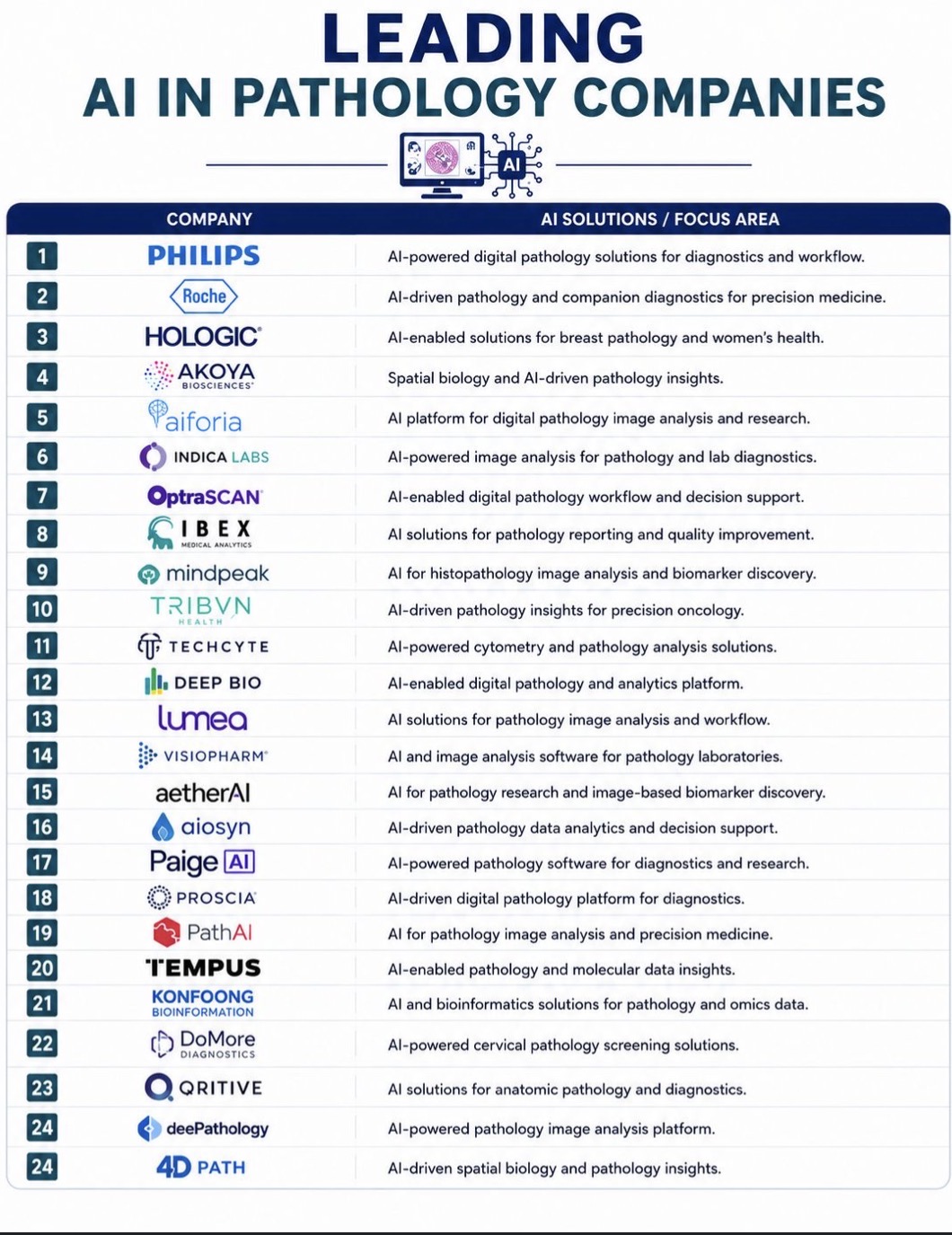
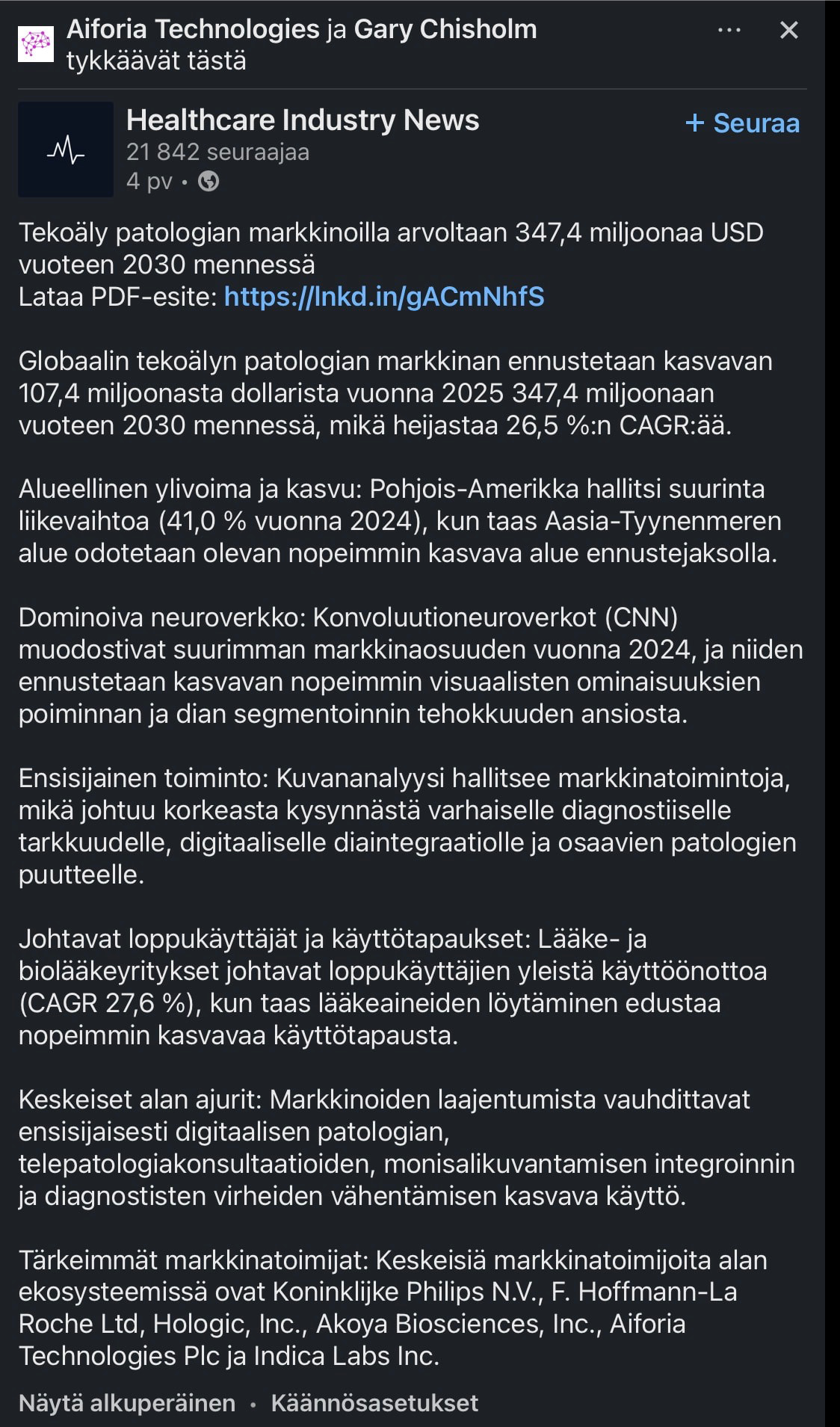
Aiforia has been named a top market player. The translation is from LinkedIn. The poster is a PR firm for a market research company. Such reports do not automatically carry the same level of reliability as the aforementioned scientific article in a decent-tier journal (even if it was funded by Big Pharma, AstraZeneca). And ranking at the top does not yet reveal anything about the absolute distribution of euros, but it does provide visibility and is a form of recognition. Those interested can provide their details there to get the full report and see the criteria in more detail. AI in Pathology Market to Reach $347.4M by 2030 | Healthcare Industry News Julkaistu aiheesta | LinkedIn
Aiforia’s previous revenue target of €100 million was, in the H1 review, calculated based on 50 potentially €500k customers in 2030. If the market research forecast for the “AI in pathology” market of $347.4 million by 2030 holds true (Aiforia’s slide even cited a source for that figure, the well-regarded Signify Research, Digital Pathology World), Aiforia would need to capture a bit less than a 10% share. That might not be impossible with “top player” status, especially if, alongside those large consolidations, they also acquire smaller clients, Pharma customers, predictive models, and expand their products beyond their current diagnostic support—as Aiforia communicates in its strategy (the aforementioned slides from 3 days ago).
Based on the published figures (including the order backlog), sales have been really modest over the past year. An attempt is being made to fix the situation by establishing a Customer Success unit and hiring a new Sales Director. The measures are logical in themselves, but the slowness of management’s reactions and corrections is concerning after such long-term and large growth investments. The company’s personnel resources have been exceptionally large compared to its revenue.
I would still like more information on what is changing in the sales strategy to achieve better results. Accounting changes are not enough to explain the extremely sluggish performance.
Aiforia out of the model portfolio. Apparently, the rise can now begin based on this old and tired thesis. I honestly don’t believe that a growth trajectory will be reached terribly quickly here, and based on the current performance, it’s probably not entirely wrong to wonder whether it will ever be reached at all.